Thursday, July 16, 2009

PRAYER IN THE NEW TESTAMENT

by Felix Just, S.J., Ph.D.

There is no single word in biblical Hebrew or Greek that signifies “prayer” in general, but rather a whole series of different words with related meanings, such as “praise, adore, give thanks, confess, bless, repent, ask, plea, beg, petition, worship, sacrifice, bow down, sing psalms, etc.”

To learn about the wide variety of “prayer” in the Bible, we can not only look at the explicit teachings about prayer by Jesus, Paul, and other biblical characters and authors, but also consider the situations in which these figures are portrayed as praying, as well as the texts of specific prayers they are said to have spoken. While all four Gospels contain some teachings and examples or prayer, by far the most prayer-related material is found in Luke’s Gospel.

GreekEnglishMattMarkLukeJohnActsPaulHebCathRevNT Total
proseuxomaito pray, speak to God1510190161915085
proseuxhprayer, request223091403336
euxomaito pray, make a vow0000230207
euxhprayer, vow0000200103
deomaito ask, beg, plead10807600022
dehsijprayer, plea, petition003001212018
eulogewto bless551311772041
euloghtojblessed0110050108
euxaristewto give thanks224322400138
euxaristiathanksgiving000011200215
euxaristojthankful0000010001
proskunewto bow down, worship13231141202460
adw & wdhto sing / song000002 / 2003 / 55 + 7
umnew & umnojto sing hymns / hymn1 / 01 / 0001 / 00 / 21 / 0004 + 2
yallw & yalmojto sing psalms / psalm000 / 200 / 24 / 301 / 005 + 7
epaitew & prosaitewto beg0021000002 + 1

Prayers spoken by Jesus himself:

  • While teaching the disciples to pray: The Lord’s Prayer (Matt 6:9-13; Luke 11:2-4)
  • Thanking the Father for hiding things from the wise, revealing them to children (Matt 11:25-30; Luke 10:21-24)
  • Before curing a deaf man, Jesus looks up to heaven, sighs, and says, "Ephphatha" (Mark 7:31-35)
  • Before calling Lazarus out of the tomb (John 11:41-42)
  • After the Last Supper discourse: Jesus’ Great Prayer to the Father (John 17:1-26)
  • While at Gethsemane (Matt 26:36-44; Mark 14:32-39; Luke 22:41-46; cf. John 18:11)
  • While hanging on the cross (Matt 27:46; Mark 15:34; Luke 23:34, 46; cf. John 19:30)

Other occasions when Jesus prays:

  • After having been baptized in the Jordan river, Jesus remains praying (Luke 3:21)
  • While living in Capernaum, Jesus goes outside of town to pray by himself (Mark 1:35; cf. Luke 5:16)
  • Before choosing his Twelve Apostles, Jesus spends the night in prayer (Luke 6:12)
  • Jesus give thanks (to God) before distributing food to 5000 people (Matt 14:19; Mark 6:41; Luke 9:16; John 6:11)
  • After feeding the 5000, Jesus goes off by himself to pray (Matt 14:23; Mark 6:46)
  • In feeding the 4000, Jesus gives thanks (to God) before distributing the loaves (Matt 15:36; Mark 8:6-7)
  • Jesus prays alone before asking the disciples who people think he is (Luke 9:18)
  • Jesus goes up a mountain with three disciples to pray, when he is transfigured (Luke 9:28-29)
  • After observing Jesus at prayer, one of his disciples asks him to reach them to pray (Luke 11:1)
  • People bring children to Jesus for him to lay his hands on them and pray (Matt 19:13)
  • Jesus prays blessings over bread and wine at the Last Supper (Matt 26:26-28; Mark 14:22-23; Luke 22:17-20)
  • Jesus prays the Peter’s faith may not fail (Luke 22:32)
  • Jesus mentions that he could call upon his Father to save him (Matt 26:53)

Wednesday, July 15, 2009

WHY DO CATHOLICS BELIEVE IN SACRED TRADITION?

Well, basically, Catholics commit themselves to the Sacred Tradition of the Church because it is out of this Tradition that Scripture came, because Scripture itself recommends and confirms this Tradition, and because nothing in Scripture says that this Tradition should cease to be authoritative in the lives of Christians once content from that Tradition was written down and canonized.

By "Sacred Tradition" I mean the various ways in which the teaching of the Apostles, the "deposit of faith," is passed on and preserved by the Church. This deposit was preserved and passed on through the writing of Sacred Scripture, which was inspired by the Holy Spirit, but it also was (and continues to be) preserved in the ordinary teaching of the successors of the Apostles (the bishops), in the writings of the early Church Fathers, in the authoritative documents of the Church (encyclicals, apostolic exhortations, dogmatic constitutions, conciliar canons, etc.), and in the liturgical worship of the faithful. Since the teaching and preaching of the Apostles has a divine origin, as does the consigning of that preaching to writing, both the preaching and the writing comprise the "Word of God" and thus "must be accepted and honored with equal sentiments of devotion and reverence" (Dei Verbum, no. 9).

Paul is particularly adamant about respecting this Tradition. He presents Scripture and Tradition as standing alongside each other (cf. 2 Thes 2:15; 2 Tim 3:10,14-15). He affirms the Tradition that his audience has received (cf. Rom 10:8,17; Gal 1:11-12; Eph 1:13-14; Col 1:5-7; Titus 1:3), commands them to follow it (cf. Phil 4:9; 1 Thes 4:1-2; 2 Thes 3:6-7; 2 Tim 1:13), and praises them when they do (cf. 1 Cor 11:2; 15:1,3,11; 1 Thes 2:13). There is simply no indication from his writing that he wished for them to do away with Tradition. Instead, he seems to be affirming it around every corner. There is also no indication that this Tradition would somehow cease to exist or to be authoritative. Instead, Paul indicates that it will continue forever (cf. 1 Tim 6:20; 2 Tim 2:2) [Peter does too, cf. 1 Pet 1:25; 2 Pet 1:12,15].

Note that, whenever "tradition" is condemned in Scripture, for example, by Jesus (cf. Mt 15:3-9; Mk 7: 8-13) or by Paul (cf. Col 2:8), what is being condemned are the traditions of men, or traditions that are contrary to the Word of God. The authentic, Sacred Tradition of the Church, however, has its very source in Jesus Christ and is preserved by the Holy Spirit working in the Church. Surely you can see why I would not think that those verses apply, and really, in order to prove that they do, you would have to prove that some element of the Sacred Tradition of the Church was contrary to the written articulation of it in Scripture.

I hope that answers your question. There are many different ways to articulate what Sacred Tradition is, and what the relationship is between it, Scripture, and the Magisterium (or teaching office) of the Church. I highly,highly suggest reading the Catechism, nos. 74-95, and Dei Verbum (Dogmatic Constitution on Divine Revelation, from the Second Vatican Council) in full.

Pax Christi,
phatcatholic

WHAT IS TRANSUBSTANTIATION?

T
ransubstantiation is what takes place in the Mass when the bread and wine become the Body, Blood, Soul, and Divinity of Jesus Christ. It is basically a way of explaining how the change from "bread" to "Jesus" takes place. In transubstantiation, theaccidents of the bread and wine remain the same while the substance of the bread and wine are changed.

Of course, in order to understand this, you have to know what "accidents" and "substance" are. Whatever the senses perceive of a thing are theaccidents of that thing. They are not the thing itself but merely the perceptible qualities or characteristics of the thing. The substance, however, is the thing itself, or rather, the essence of the thing.

So, take for example the bread used in Mass. The accidents of it are: roundness, whiteness, crispiness, bread-like smell, bread-like taste. The substance of it is: "bread." Our senses perceive the accidents; only the mind knows the substance.

In every case in the universe but one, when the substance changes, the accidents of it change too since the accidents are attached to (or, exist in) the substance. For example, when a caterpillar becomes a butterfly, it also changes in outward appearance b/c, well, butterflies have different outward characteristics than caterpillars do.

Only in the transubstantiation of the Eucharistic elements does the accidents remain even though the substance changes. Maybe an illustration will be helpful. I saw a magic trick once where a man in a black costume stood in the middle of the stage. Some assistants pulled up a curtain around him. There was smoke and flashes of light. When they dropped the curtain to the floor there stood a woman in the same black costume. Transubstantiation is kinda like that. The "costume" of bread is suspended ("in mid air" so to speak) while the underlying substance (or thing that wears the costume) is changed.

I hope that helps you to make sense of this mystery. It is universally accepted that all created things have accidents and substance. The only quarrel is over whether or not God desires to suspend the laws of the universe in this one instance in order to be substantially present in the Eucharist.

There are two articles that I highly suggest if you would like to learn more about transubstantiation:Thank you for your question.

Pax Christi,
phatcatholic

Tuesday, July 14, 2009

CLUSTER PAUL CLP BANNER


Special Thanks to Bro.Fred Medina

Monday, July 13, 2009

THE ANGELUS

THE ANGELUS
BAR

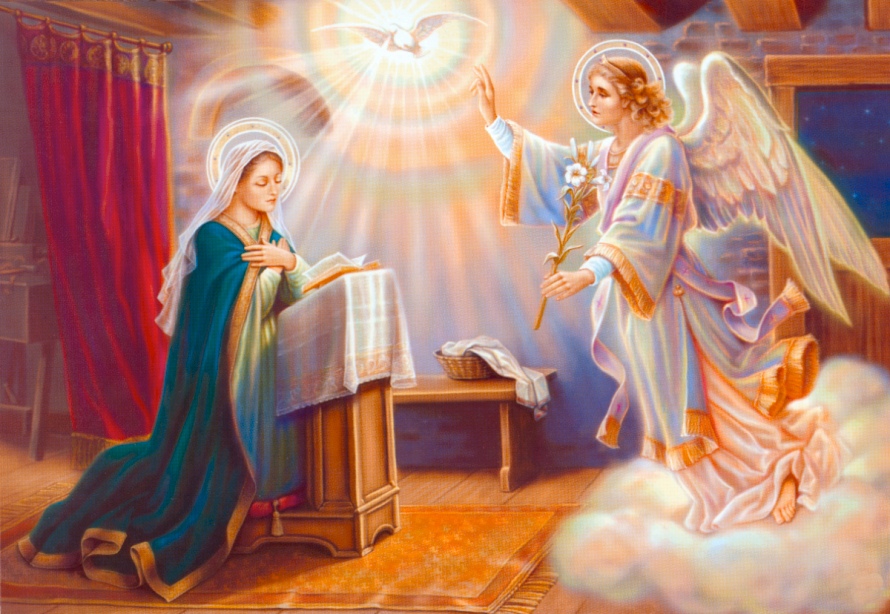
V. The Angel of the Lord declared unto Mary.
R. And she conceived by the Holy Spirit. [Recite the Hail Mary]

V. Behold the handmaid of the Lord.
R. Be it done unto me according to Thy word. [Recite the Hail Mary]

V. And the Word was made flesh.
R. And dwelt among us. [Recite the Hail Mary]

V. Pray for us, O Holy Mother of God.
R. That we may be made worthy of the promises of Christ.

[THE HAIL MARY]

Hail Mary, full of grace, the Lord is with thee.
Blessed art thou among women, and blessed is
the fruit of thy womb, Jesus.
Holy Mary, Mother of God, pray for us sinners,
now, and at the hour of our death. Amen.

LET US PRAY:

Pour forth, we beseech Thee, O Lord, Thy grace into our hearts;
that we to whom the Incarnation of Christ, Thy Son, was made known by the
message of an Angel, may by His Passion and Cross, be brought to the glory
of His Resurrection through the same Christ Our Lord. Amen.

PROMISE:
"Whoever shall devoutly recall to me the joy I felt upon uttering the words,
"Behold the handmaid of the Lord," I will most truly show him that I am
his Mother, and unfailingly, I will succor him."

----- The Blessed Mother to St. Gertrude the Great


Sunday, July 12, 2009

THE REAL PRESENCE

Thursday, July 9, 2009

THE BEAUTIFUL HANDS OF A PRIEST


Tuesday, July 7, 2009

CARITAS IN VERITATE

Caritas in Veritate

ENCYCLICAL LETTER
CARITAS IN VERITATE
OF THE SUPREME PONTIFF
BENEDICT XVI

TO THE BISHOPS
PRIESTS AND DEACONS
MEN AND WOMEN RELIGIOUS
THE LAY FAITHFUL
AND ALL PEOPLE OF GOOD WILL

ON INTEGRAL HUMAN DEVELOPMENT
IN CHARITY AND TRUTH


Read the Pope's New Encyclical

Listen to this article. Powered by Odiogo.com


WEEKLY HOUSEHOLD GUIDE: July 2009

Weekly Household Guide

Week 1 - July 6-10

1 Cor 6:17

Verse:

But he who joins himself to the Lord becomes spiritually one with Him.


Reflection:

As Couples for Christ, we all endeavor to truly be one with Christ reflecting

His mind, heart and will in our lives.

The decision to be “for” Christ necessitates a decision to truly bind ourselves as one in the Lord.

As we grow in oneness of Spirit, people begin to see Jesus in us.

    • We reflect God’s life within us.
    • We dwell in God’s presence.
    • We persevere in imitating Jesus and the Father.
    • We embrace God’s training and discipline.

These external manifestations of the Spirit in our lives become the seedbed for concreteChristian witness, as God uses us as instruments for making His presence in the world seen and felt by others, who as yet do not know Him.


Discussion Question:

  1. In my years as CFC, how deep I have grown in familiarity and oneness in spirit with Christ:
    • reflecting His life within me?
    • dwelling in His presence?
    • imitating His example?
    • embracing His training and discipline?

Weekly Household Guide

Week 2 - July 13 to 17

    1 Cor 6:19-20

Verse:

“Don’t you know that your body is the temple of the Holy Spirit who lives in you and who was given to you by God?”

Reflection:

Every time we talk of the body being a temple of the Holy Spirit, we are drawn to focus on the aspect of purity of the flesh. But the body is more than just physical. Beyond physical purity then which we should keep, we should also actively advocatepurity of heart and spirit truly reflecting our being born of the Father, and child of God.


How is this reality manifested in our presence?

    − What do our eyes behold?

    Do we see more good than bad?

    − What do our ears hear?

    Do we hear God’s promptings beyond what people say?

    − What do our mouths declare?

    Do we proclaim God and His goodness in all?

    − What do our hands touch?

    Do our hands touch to heal, to give, and to nourish?

    − What do our feet pursue?

    Do we walk only towards the light and shun what is dark and evil?

Our body, temple of the Holy Spirit needs to constantly be kept pure.


Discussion Question:

  1. How are we actively keeping our bodies truly fit to be the Spirit’s dwelling place.
  2. Is the Spirits within us, truly glorified or wrongly oppressed?

Weekly Household Guide

Week 3 - July 20-24

1 Cor 7:1

Verse:

A man does well not to marry.

Reflection:

Marriage was instituted by God to call man and woman to oneness in raising humankind.

The oneness desired is to be reflective of the unity that binds Father, Son and Spirit. It is a tall task, one that can only find fulfillment, where God is a party to the marriage.

It is His grace that makes the union possible. Human efforts of even both husband and wife, and even with the best they can and will give, are doomed to fall short and fail where God is absent.

A man who decides to marry must know that this is what God expects of him, and must likewise decide to plead with God for the grace of His uniting Spirit.

Discussion Questions:

1) Do we acknowledge God’s role in our marriage?

2) How have we invited God’s participation in building our home for God?

3) What manifestations of God’s power are reflected in our union?


Weekly Household Guide

Week 4 - July 27-31

1 Cor 7:3

Verse:

A man should fulfill his duty as a husband and a woman should fulfill her duty as a wife, and each should satisfy the other’s needs

Reflection:

What are the duties of spouses to one another; what are husbands accountable to their wives about, and what are wives, in turn accountable to their husbands about?

Duty implies a promise, a covenant by the pact of matrimony, sealed with God as witness in the sacrament. Duty here, then implies full knowledge, full consent, and full commitment. Rendering the duty is therefore a must.

It is both spouses’ commitment to seek the good of their beloved in all aspects of welfare in both body and spirit.

Spiritual oneness pursued in seeking each other’s mind, heart and will in all aspects of couple life: individual needs, marriage and family goals, the raising of children, building a home for God- nourishing, strengthening and enhancing the union, needs to find full physical expression in the couple’s sex life.

As in the spiritual and emotional realms, both spouses must seek to satisfy one another’s physical needs for intimacy and oneness.

All efforts at unity and coming together of both persons must converge on the marital bed, where two are physically made one.

Out of this Eucharist then, God calls life to birth and blesses it.


Discussion Questions:

  1. How faithful are we to every aspect of our marital duty as spouses?
  2. In what areas do we need Godly intercession?

Monday, July 6, 2009

ARE YOU BORN AGAIN?

Steve Ray on Catholic Answers Live!

To listen on-line click here and for other listening options, click here

It seems that God is kind of predictable in a way :-) since He always starts new things in the same way – with “water and the Spirit“. Consider the following:

1) The first creation came from the the earth which was covered with WATER and the SPIRIT hovered over the waters and from the water emerged land and man and God’s first creation (Gen 1:1-2).

NoahsArk3.jpg2) A new humanity was started with Noah through WATER and SPIRIT. The ark went through the water and a dove (representing the Spirit) hovered overhead with an olive branch. Peter said this represents baptism which “now saves us” (1 Peter 3:18-21).

3) The nation of Israel was created through the WATER of the Red Sea (baptism) with the cloud and fire of the Holy SPIRIT overhead — my oh my, again we have water and Spirit (Ex 14).

4) Ezekiel then describes what the New Covenant will look like and he said we will be sprinkled with clean WATER and his SPIRIT will be placed in us (Ez 36:25). Born again, I suspect.

5) Then Jesus, right before saying you must be born of “water and the Spirit” had just gone down into the WATER of the Jordan and the SPIRIT came down and landed on his head. Again, water and the Spirit (Mt 3:16;Jn 1:29).

6) Jesus teaches Nicodemus that he must be born again, or from above which is accomplished through “WATER and the SPIRIT.“

7) When Jesus finished these words what was the first thing he did? He went down and baptized people in the Jordan with his disciples (Jn 4:1-2).

8) At the first Holy Ghost Gospel Revival meeting :-) Peter stood up at Pentecost and said, “Repent, and be baptized (WATER) every one of you in the name of Jesus Christ for the forgiveness of your sins; and you shall receive the gift of the Holy SPIRIT“ (Acts 2:38).

9) Peter also says “Baptism now saves you“ (1 Pet 3:18), and Paul is told “Rise and be baptized, and wash away your sins, calling on his name” (Acts 22:16), and Paul writes that we are saved “by the washing of regeneration (WATER) and renewal in the Holy SPIRIT“ (Titus 3:5).

Other verses mentioned on the show — click here!

For my article on Infant Baptism, click here

*******************************************************

JordanSm.jpgToo bad many Evangelicals and Fundamentalists refuse to see it but the Bible is pretty clear about new birth through the sacrament of baptism. Jesus is not ambiguous in this matter and he is alluding quite clearly to new beginnings in the Old Testament. The Early Church is also very clear and so is the teaching of the Catholic Church today.

(Picture to right is the place in the Jordan River where Jesus was baptized. Click for larger image.)

St. Augustine said, “Who is so wicked as to want to exclude infants from the kingdom of heaven by prohibiting their being baptized and born again in Christ?”

When someone asks me “Have you been born again?“ I simply answer “Absolutely, but I’ve been born again the Bible Way!“

Friday, July 3, 2009

MY MOTHER AND MY QUEEN

Thursday, July 2, 2009

THE THREE HAIL MARYs


Here is how the Little Chaplet is said:

Introductory prayer (said only once i.e., when beginning the devotion).

Eternal Heavenly Father, through the Immaculate Heart of Mary I offer Thee this Little Chaplet of three Hail Marys for all the Holy Souls in Purgatory and for the souls of all poor sinners on earth, especially Bishops, Priests, and Religious, and those within my home and family; according to Thy most holy Will; in Jesus Name and in the unity of the Holy Ghost, one God forever and ever. Amen.

Mary ever virgin, Daughter of the Father, pray for us.
Mary ever virgin, Mother of the Son, pray for us.
Mary ever virgin, Spouse of the Holy Ghost, pray for us.

On the Cross: Make the Sign of the Cross and say the Apostle’s Creed.

On the first Large Bead: Say the Lord’s Prayer.

On the three small beads: Say one Hail Mary each.

On the second Large Bead: Say the "Glory be to the Father…" the "O my Jesus, forgive us" (Fatima Prayer)… Then add:
Jesus in the most Blessed Sacrament, have mercy on us.
Our Lady of the most Blessed Sacrament, pray for us.
Holy Angels and Saints of the living God, pray for us.
Amen.

The beads may then be turned around and the entire Chaplet repeated using the beads in the other direction, starting with the Cross or medal on that end. I find that this arrangement works well in every situation, but especially when I am driving, during which time I pray the Little Chaplet over and over again.

When finished saying the devotion, use the Crucifix to make the Sign of the Cross, kissing it.

THE HOLY GHOST


Wednesday, July 1, 2009

IHS - July 2009

IN HIS STEPS

2009


JULY

LISTEN

At the end of July, we will commemorate the feast of St. Ignatius of Loyola. The saint is popularly known today as the advocate of Ignatian spirituality. which has its foundation in discernment.

Discernment is about dwelling in the silence of our innerselves. It is about touching base with our conscience. Discernment is about listening to God's voice within us. Gos speaks from within us. His voice is not in the mind, not in the earthquake, not in the fire - but in the tiny whispering sound, that even drew Elijah to hide his face in the cloak.

In the mad rush of the world, our race with time, and all the noise, confusion and drudgery that these bring, God speak to us in the quiet. We need to be still to experience God, understand His will. Listening entails giving space, time, effort and love.

Our prayer is that we be able to extend the ears of our hearts to God, and not just hear Him, but truly give of ourselves as we listen, so that we may be enabled to respond


READ or PRINT
Choose date of your household

download_trans.gif Download