Sunday, July 6, 2008

JULY: Sambuhay - Euchalette - Patnubay Sa Misa

FOR UP-TO-DATE SAMBUHAY-EUCHALETTE-PATNUBAY COPIES:

GO HERE:


YEAR A


To download a copy of the Sambuhay, Euchalette or Patnubay sa Misa, simply click on any of the dates available below.


Only Sambuhay are PASSWORD protected.
(standard CFC password applies)


S A M B U H A Y

July 04

First Friday

July 06

14th Sunday in Ordinary Time

July 13

15th Sunday in Ordinary Time

July 20

16th Sunday in Ordinary Time

July 27

17th Sunday in Ordinary Time


E U C H A L E T T E

[source]

June 29

Sts. Peter & Paul, Apostles

July 06

14th Sunday in Ordinary Time - July 6, 2008

July 13

15th Sunday in Ordinary Time - July 13, 2008

July 20

16th Sunday in Ordinary Time - July 20, 2008

July 27

17th Sunday in Ordinary Time - July 27, 2008

Euchalette can be used in lieu of Sambuhay

PATNUBAY SA MISA

Hunyo 29

Dakilang Kapistahan ni San Pedro at San Pablo

Hulyo 06

Ika-14 Linggo sa Karaniwang Panahon

Hulyo 13

Ika-15 Linggo sa Karaniwang Panahon

Hulyo 20

Ika-16 Linggo sa Karaniwang Panahon

Hulyo 27

Ika-17 Linggo sa Karaniwang Panahon

Patnubay Sa Misa ay alternatibo sa Sambuhay

IN HIS STEPS - July - August - September 2008


IHS Copy

You can download PDF copies from these links:

July - August - September


For regular PDF issue of In His Steps please visit:

Cluster 2 Chapter D - Pastoral Formation Resources
(CFC standard password is not applicable you have to email me for the password)
cluster.2.chapter.d@gmail.com

IHS courtesy of T2 Joey/Ta Grace

Tuesday, July 1, 2008

DAILY SCRIPTURE READING - July 2008

http://www.dailyscripture.net/

These readings are intended as an aid for daily prayer and meditation. The selection of gospel passages follow the daily church readings for the season.

The scripture quotations are from the Revised Standard Version of the Bible, copyright 1973 by the Division of Christian Education, National Council of Churches. The meditations are written by Don Schwager.


2008

JULY

1 2 3 4 5 6 7 8 9 10 11 12 13 14 15 16 17 18 19 20 21 22 23 24 25 26 27 28 29 30 31


AUGUST

1 2 3 4 5 6 7 8 9 10 11 12 13 14 15 16 17 18 19 20 21 22 23 24 25 26 27 28 29 30 31

Tuesday, June 24, 2008

PraySTATION: Prayer For The Sick

"And the prayer of faith will save the sick person, and the Lord will raise him up. If he has committed any sins, he will be forgiven. Therefore, confess your sins to one another and pray for one another, that you may be healed. The fervent prayer of a righteous person is very powerful."
James 5:15-16

Amidst the CFC 27th Anniversary celebration our dear Tito Bert Banzon (scheduled to go under the knife) and Tita Tess (waiting for the biopsy result) still found time to join the festivities at the Quirino Grandstand last Saturday - June 21, 2008.

Prayer Request For Our Dear
Tito Bert Banzon and Tita Tess Lumbao
and most especially to our
Tita ELVIE SEVA
who is suffering from CANCER!

LET US PRAY:

Dear Jesus, Divine Physician and Healer of the sick, we turn to you in this time of illness. O dearest comforter of the troubled, alleviate our worry and sorrow with your gentle love, and grant us the grace and strength to accept this burden. Dear God, we place our worries in your hands. We place our sick under your care and humbly ask that you restore your servant to health again. Above all, grant us the grace to acknowledge your will and know that whatever you do, you do for the love of us.

Amen.


Sunday, June 22, 2008

DO YOU MISS US?

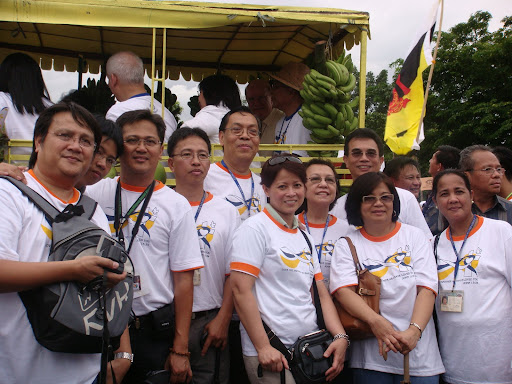
June 21, 2008 Quirino Grandstand


Getting ready for the Harvest Parade


KAYESAY DELEGATES
Riy...Kho...Yen...


O sampol lang iyan ha!
We miss you too!!!

Friday, June 6, 2008

OUR SPIRITUAL JOURNEY...

after CONVERSION... comes TRANSFORMATION...

...but all TALKS and no scripture study makes one's spiritual journey incomplete


St. Jerome insist that ignorance of scripture means ignorance of Christ.

I dare say
ignorance
of the Catechism of the Catholic Church
means ignorance of our Catholic FAITH
.

IT'S NOW TIME FOR SOME SERIOUS...
CATHOLIC EDUCATION!!!

“You shall love the Lord your God with all your heart,
and with all your soul,
and with all your
mind,”
(Matt 22:37; Mark 12:30; Luke 10:27)

Do you LOVE me?
F E E D M Y L A M B S !


Pax Christi,
CATECHIST-FOR-ALL


Thursday, June 5, 2008

CLUSTER 2's GOT YFC POWER


GRANDPARENTS

GRANDPARENTS

Pope Benedict XVI, Shepherd of Truth

Notable quotations from Pope Benedict XVI and official
teachings of the Roman Catholic Church

Pope Benedict XVI

"A TREASURE"

"In no way should [grandparents] ever be excluded from the family circle. They are a treasure which the younger generations should not be denied, especially when they bear witness to their faith." (Address at the Fifth World Meeting of Families, Valencia, July 8, 2006).

SPECIAL ATTENTION

The Church has always paid special attention to grandparents, recognizing them as a great treasure from both the human and social, as well as religious and spiritual viewpoints.

"IMPORTANT ROLE"

In the past, grandparents had an important role in the life and growth of the family. Even with their advancing age they continued to be present with their children, their grandchildren and even their great-grandchildren, giving a living witness of caring, sacrifice and a daily gift of themselves without reserve.

WITNESSES OF HISTORY

They were witnesses of a personal and community history that continued to live on in their memories and in their wisdom.

"BETTER VALUED"

It is necessary to join forces to defeat together all forms of marginalization, for it is not only they � grandfathers, grandmothers, senior citizens � who are being injured by the individualistic mindset, but everyone. If grandparents, as is often said and on many sides, are a precious resource, it is necessary to put into practice coherent choices that allow them to be better valued.

"THE LIGHT OF THE TRUTH"

Old age, with its problems that are also linked to the new family and social contexts because of modern development, should be evaluated carefully and always in the light of the truth about man, the family, and the community. It is always necessary to react strongly to what dehumanizes society.

"THE JOY OF LIVING"

May grandparents return to being a living presence in the family, in the Church and in society. With regard to the family, may grandparents continue to be witnesses of unity, of values founded on fidelity and of a unique love that gives rise to faith and the joy of living.

(Source: Address to Pontifical Council for the Family, April 5, 2008)

Wednesday, June 4, 2008

THE CHARISM OF DISCERNMENT

Excerpts from Fr. Cantalamessa's book Come, Creator Spirit...
... the charism (that is, Holy Spirit inspired gift) of discernment whereby Christians can distinguish between:
  • what comes from the Holy Spirit,
  • what comes from our own minds, and;
  • what comes from the Evil One.
A charism is more than common sense and shrewdness (although those strengths are indeed natural gifts from God for which we should express humble gratitude). A charism is supernatural: "the Holy Spirit helps us evaluate situations and to direct our choices, not only on the basis of human wisdom and prudence, but also in the light of the supernatural principles of faith" (p. 333).
How to tell if something is from the Evil One? "Paul gives the same objective criterion of discernment that Jesus gave: the fruits. The 'works of the flesh' show that the sinful desire giving rise to them comes from the old nature, and 'the fruits of the Spirit' show that the desire from which they spring comes from the Spirit (see Ga 5:19-22). 'For what the flesh desires is opposed to the Spirit, and what the Spirit desires is opposed to the flesh' (Gal 5:17)." Note that the desires of the flesh are not merely desires for sexual activity outside of true marriage; the desires of the flesh could also be the Vatican cleric who puts ambition above Gospel service, or simply the person who is compulsively and intemperately attacking, slandering, and criticizing others. Self-righteousness is as much a desire of the flesh as lust. So is greed and lust for control and power over others.
How to choose between two goods? "Saint Ignatius Loyola developed his teaching on discernment mainly as a response to the needs of such a situation. He suggests that we take note of one thing in particular: our own inward dispositions, the intentions (the 'spirits') that underlie our choice. . . . Ignatius Loyola suggested practical ways to apply these criteria. As an example, when two possible choices are open to you, it is good to settle on one of them as though that were without question your choice and to stay with that for a day or more; then stop and evaluate how you really feel in your heart about that choice. Are you at peace about it, is it in harmony with all the other choices you have made, do you feel inwardly encouraged to follow that route, or on the other hand does it leave you under a veil of disquiet? Repeat the process with the other choice open to you. Do it all in an atmosphere of prayer, of abandonment to God's will and openness to the Holy Spirit" (p. 334).
Fr. Cantalamessa then gives a good biblical overview of discernment as follows: "When you come right down to it, it is simply a question of putting into practice the advice that Jethro gave to Moses: Put the questions to God, and wait in prayer for God's answer (see Exod 18:19). A deep-seated habitual disposition to do God's will whatever the situation puts you in the best position to discern well. Jesus says: 'My judgment is just, because I seek to do not my own will but the will of him who sent me' (John 5:30)' " (p. 334).

Tuesday, June 3, 2008

GOD LOVES A CHEERFUL GIVER

The biblical principle of giving,
is that we give whatever we feel moved to give from our hearts,
without
compulsion.


"Consider this: whoever sows sparingly will also reap sparingly, and whoever sows bountifully will also reap bountifully. Each must do as already determined, without sadness or compulsion, for God loves a cheerful giver. Moreover, God is able to make every grace abundant for you, so that in all things, always having all you need, you may have an abundance for every good work."
2 Corinthian 9:6-8


"So whoever is in Christ is a new creation: the old things have passed away; behold, new things have come." 2 Corinthians 5:17

Monday, June 2, 2008

COUPLES FOR CHRIST 27th Anniversary

cfcaniv


Download Schedule of Activities

HERE


We'll be there!

with Fifieh & Nyko

June 17 - 19 - 21

Dr. SCOTT HAHN's Free On-line classes!

Courses of Study at SalvationHistory.com!

Welcome to our free on-line classes!

Below you will find links to our several Study "Tracks." Each track is designed to increase your knowledge of sacred Scripture and your faith in its promises.


Each track includes three individual courses. Each course contains a complete text, including cross-references and links to Scripture and other Church documents. In addition, for each track of study we recommend books that will enhance your study and prayer and build your library of essential works in biblical theology and spirituality.

Our studies are free. But we do request that you register. For more information, including tips on guided study based on these on-line classes, see here.


Salvation History Track
A course of study designed to introduce students to the main events and themes of salvation history as recorded in the pages of Scripture. [Learn More]

Course One:
Covenant Love: Introducing the Biblical Worldview

Course Two:
The Lamb's Supper: The Bible and the Mass

Course Three:
‘He Must Reign': The Kingdom of God in Scripture


Apologetics Foundations Track
A course of study specially designed for students seeking to learn more about the biblical basis of Catholic beliefs and devotion. [Learn More]
Course One:
Genesis to Jesus
Course Two:
The Lamb's Supper: The Bible and the Mass
Course Three:
Holy Queen: The Mother of God in the Word of God


Biblical Theology Track
A course of study designed to introduce students to the main issues and themes in biblical theology, which is the study of the Bible as a unified whole that expresses God's Word as revealed by Jesus Christ. [Learn More]

Course One:
Covenant Love: Introducing the Biblical Worldview

Course Two:
Reading the Old Testament in the Gospel of Matthew

Course Three:
The Lamb's Supper: The Bible and the Mass

Sunday, June 1, 2008

JUNE: Euchalette or Patnubay Sa Misa

YEAR A


To download a copy of the Euchalette or Patnubay sa Misa, simply click on any of the dates available below.


A Reflection is provided for separate printing.

June 01

Ninth Sunday in Ordinary Time

June 08

Tenth Sunday in Ordinary Time

June 15

Eleventh Sunday in Ordinary Time

June 22

Twelfth Sunday in Ordinary Time

June 29

Solemnity of Ss. Peter & Paul


E U C H A L E T T E

June 1

9th Sunday in Ordinary Time

June 8

10th Sunday in Ordinary Time

June 15

11th Sunday in Ordinary Time

June 22

12th Sunday in Ordinary Time

June 29

Sts. Peter & Paul, Apostles

Euchalette can be used in lieu of Sambuhay

PATNUBAY SA MISA

Hunyo 1

Ika-9 na Linggo sa Karaniwang Panahon

Hunyo 8

Ika-10 na Linggo sa Karaniwang Panahon

Hunyo 15

Ika-11 na Linggo sa Karaniwang Panahon

Hunyo 22

Ika-12 na Linggo sa Karaniwang Panahon

Hunyo 29

Dakilang Kapistahan ni San Pedro at San Pablo

Patnubay Sa Misa ay alternatibo sa Sambuhay


DAILY SCRIPTURE READING - June 2008

http://www.dailyscripture.net/

These readings are intended as an aid for daily prayer and meditation. The selection of gospel passages follow the daily church readings for the season.

The scripture quotations are from the Revised Standard Version of the Bible, copyright 1973 by the Division of Christian Education, National Council of Churches. The meditations are written by Don Schwager.


2008

JUNE

1 2 3 4 5 6 7 8 9 10 11 12 13 14 15 16 17 18 19 20 21 22 23 24 25 26 27 28 29 30

Thursday, May 29, 2008

The Chaplet of The Divine Mercy


1. Begin with the Sign of the Cross, 1 Our Father, 1 Hail Mary and The Apostles Creed.

2. Then on the Our Father Beads say the following:

Eternal Father, I offer You the Body and Blood, Soul and Divinity of Your dearly beloved Son, Our Lord Jesus Christ, in atonement for our sins and those of the whole world.

3. On the 10 Hail Mary Beads say the following:
For the sake of His sorrowful Passion, have mercy on us and on the whole world.

(Repeat step 2 and 3 for all five decades).

4. Conclude with (three times):
Holy God, Holy Mighty One, Holy Immortal One, have mercy on us and on the whole world.


DIVINE MERCY

Minute Meditation - Believe in His Goodness

Best%2BDivine%2BMercy.jpeg (448x410 pixels)

“Be merciful, just as your Father is merciful.”~ Luke 6:36

The flames of are burning Me — clamoring to be spent; I want to keep pouring them out upon souls; souls just don’t want to believe in My goodness.

~ to St. Faustina


Divine Mercy


Divine Mercy Sunday is the Sunday following Easter. The Divine Mercy Novena begins on Good Friday.


How to Pray the Chaplet of Divine Mercy:

Begin with the Sign of the Cross, 1 Our Father, 1 Hail Mary and The Apostles Creed.

Sign of the Cross:
In the name of the Father, and of the Son, and of the Holy Spirit


Our Father:

Our Father, Who art in heaven, Hallowed be Thy Name. Thy Kingdom come. Thy Will be done, on earth as it is in Heaven. Give us this day our daily bread. And forgive us our trespasses, as we forgive those who trespass against us.And lead us not into temptation,but deliver us from evil. Amen

The Hail Mary:

Hail Mary,Full of Grace,The Lord is with thee.Blessed art thou among women,and blessed is the fruitof thy womb, Jesus.Holy Mary, Mother of God,pray for us sinners now,and at the hour of death. Amen

The Apostles Creed:

I believe in God, the Father Almighty, Creator of Heaven and earth; and in Jesus Christ, His only Son Our Lord, Who was conceived by the Holy Spirit, born of the Virgin Mary, suffered under Pontius Pilate, was crucified, died, and was buried. He descended into Hell; the third day He rose again from the dead; He ascended into Heaven, and sitteth at the right hand of God, the Father almighty; from thence He shall come to judge the living and the dead. I believe in the Holy Spirit, the holy Catholic Church, the communion of saints, the forgiveness of sins, the resurrection of the body and life everlasting. Amen

Then on the larger beads say the following:

Eternal Father, I offer You the Body and Blood, Soul and Divinity of Your dearly beloved Son, Our Lord Jesus Christ, in atonement for our sins and those of the whole world.

On the 10 smaller beads say the following for all 5 decades:

For the sake of His sorrowful Passion,
have mercy on us and on the whole world.


Conclude with (three times):

Holy God, Holy Mighty One, Holy Immortal One,
have mercy on us and on the whole world.


There are two scriptural verses that we should keep in mind as we involve ourselves in these devotional practices:

“This people honors me with their lips, but their hearts are far from me” (Is 29:13)


“Blessed are the merciful, for they shall obtain mercy” (Mt5:7)

It’s an ironic and somewhat frightening fact that many of the most religious people of Christ’s time (people who were actively practicing their religion and eagerly awaiting the promised Messiah) were not able to recognize Him when He came.

The Pharisees, to whom Christ was speaking in the first quotation above, were very devoted to the prayers, rules, and rituals of their religion; but over the years, these outer observances had become so important in themselves that their real meaning had been lost. The Pharisees performed all the prescribed sacrifices, said all the right prayers, fasted regularly, and talked a lot of about God, but none of it had touched their hearts. As a result, they had no relationship with God, they were not living the way He wanted them to live, and they were not prepared for the coming of Jesus.

When we look at the image of the Merciful Savior, or pause for prayer at three o’clock, or pray the Chaplet — are these things drawing us closer to the real sacramental life of the Church and allowing Jesus to transform our hearts? Or have they just become religious habits? In our daily lives are we growing more and more as people of mercy? Or are we just giving “lip service” to God’s mercy?

SACRIFICE OF THE MASS

Biblical Overview: Sacrifice of the Mass

Monday, February 26, 2007

I. DEFINITION OF SACRIFICE OF THE MASS
The re-presentation, re-enactment, and effective application of the merits gained by Jesus by His one sacrifice at Calvary on the Cross. Jesus' death in past history is present to God (e.g., Rev 5:6; 13:8). In each Mass, His sacrifice is made real and present to us, transcending space and time. Jesus Himself offers each Mass by means of human priests, who act in His stead. As in the Last Supper, Jesus is both Priest and Victim. The congregation also participates in the offering, like the disciples at the Last Supper, although with more understanding.

II. SCRIPTURAL EVIDENCE FOR THE SACRIFICE OF THE MASS

1. General Hints in the Old Testament

The Eucharist is prefigured in the Tree of Life in Eden, the sacrifices of Abraham and Melchisedech, the manna in the desert, the Shew-bread in the Temple, and the various sacrifices of the Old Covenant (e.g., Lev 23:13), especially the Paschal Lamb. If the Jews had the visible glory of God present in their Tabernacle and Temple, we should expect to have the same God present in our Tabernacles (in each Catholic church).

2. Genesis 14:18 / Psalm 110:4

"And Melchizedek king of Salem brought forth bread and wine: and he {was} the priest of the most high God."

"The Lord hath sworn, and will not repent, Thou {art} a priest for ever after the order of Melchizedek."

{Cf. Heb 5:6; 7:1 ff.}

A. OT Prophecies The OT prophesied that Jesus would offer a true sacrifice to God, and implied it would be bread and wine, "after the order of Melchizedek." Thus, as the Fathers of the Church held, the Sacrifice of the Mass is spoken of, since this description doesn't fit the bloody sacrifice at Calvary. The specific duty of a priest, by definition, is sacrifice. Jesus, like Melchizedek, is King and Priest at the same time. It's interesting to note also that "Salem" is regarded as ancient Jerusalem by Bible scholars (see, e.g., Ps 76:2), giving all the more significance to the above information.

3. Isaiah 66:18,21 ". . . I will gather all nations and tongues . . . (21) And I will also take of them for priests {and} for Levites, saith the Lord."

A. Here is proclaimed a priesthood among the Gentiles in the Church Age, which necessarily entails the element of sacrifice. The Catholic Church (and Eastern Orthodoxy) possesses this; Protestantism doesn't, citing only the "priesthood of all believers."

4. Malachi 1:11 "For from the rising of the sun even unto the going down of the same my name {shall be} great among the Gentiles; and in every place incense {shall be} offered unto my name, and a pure offering: for my name {shall be} great among the heathen, saith the Lord of hosts."

A. God is proclaiming a new, clean sacrifice, again among the Gentiles, and clearly universal ("in every place"). Thus, the Sacrifice of the Cross cannot be intended, since it was in one place only. The Mass fulfills the prophecy.

5. The Book of Hebrews

A. The theme of this book is Jesus as our High Priest. As such, the verses relevant for our topic are too numerous to cite in their entirety. Heb 13:10 refers to an "altar"; the other verses below have to do with Jesus' priestly mission. In Protestant interpretation, they are basically "spiritualized" away. For the Protestant, broadly speaking, Jesus is a Priest only insofar as He dies sacrificially and does away with the OT notion of the priesthood and animal sacrifice. This is not false but it is only a partial truth. For the Catholic, there is much more of a sense of the ever-present nature of the Sacrifice of Calvary, due to the nature of the Mass, rather than considering the Cross a past event alone.

B. "Priestly" Verses

2:17
3:1
4:14-16
5:1-10
6:20
7:1-28 (entire)
8:1-6
9:11-15, 24-28
10:19-22

6. The "Altar" in Heaven in the Book of Revelation

A. Revelation (called the Apocalypse by Catholics) describes an altar in heaven before God's throne. This is curious if Protestantism is correct about the need for altars being abolished with the death of Jesus and the end of the OT system of sacrifice and priests. In actuality, the Bible is a continuous whole from Genesis to Revelation, with no radical discontinuity between the OT and NT or Old and New Covenants, as Protestantism is wont to believe. In Revelation we find the "altar" or "golden altar" being mentioned in 6:9; 8:3-5; 9:13; 11:1; 14:18; and 16:7.

The climactic scene of this glorious portrayal of heaven occurs in Rev 5:1-10. Verse 6 describes the "Lamb as it had been slain." The Lamb (Jesus) is "in the midst of the throne" (5:6) which is in front of the "golden altar" (8:3). Is this presentation of Jesus as "Lamb" to the Father a one-time event or an ongoing occurrence (from God's perspective, timeless)? We have strong biblical indications that the latter is more accurate. The sacrifice made "once" in Heb 7:27 refers to the human, historical death on Calvary of Jesus. However, there is a transcendent aspect of the Sacrifice as well. Rev 13:8 describes "the Lamb slain from the foundation of the world," and Heb 7:24-5 informs us that:

But this {man}, because he continueth ever, hath an un-changeable priesthood. (25) Wherefore he is able also to save them to the uttermost that come unto God by him, seeing he ever liveth to make intercession for them.
In conclusion, it is evident that Hebrews and Revelation are suffused with a "Catholic worldview." The realms depicted are filled with "Catholic air," so to speak. The Sacrifice of the Mass, rightly understood, fulfills every aspect of the above passages, most particularly in the sense of Jesus as the ultimate Priest for whom the earthly priest "stands in," and in the timeless and transcendent character of the Sacrifice "made present" at Mass, but never deemed to be an addition to, or duplication of, the one bloody Sacrifice of our Lord at Calvary.

III. AFTERWORD (Thomas Howard)

This divine love is such that not only does God give Himself to us and for us but, unimaginably, takes us into this very mystery of self-giving and makes us one with His Son, calling us the very Body of this Son who offers Himself to the Father. The bread of the E is the Body of Christ, and the Church is the Body of Christ; and that Body - both Christ's personal body and his Body the Church - like bread, has only one reason for being: to be broken and given. All is offering; all is sacrifice; all is oblation. Worship without oblation is no worship.

{Evangelical is Not Enough}

Written by Dave Armstrong

THROUGH BAPTISM AND THE EUCHARIST

Biblical Evidence For Salvation Through Baptism and the Eucharist


[ source ]


Catholics (like many Protestants) believe in baptismal regeneration, and we also believe that the Eucharist has a direct relation to salvation in some respect, based on passages such as the following:
Acts 2:38 And Peter said to them, "Repent, and be baptized every one of you in the name of Jesus Christ for the forgiveness of your sins;

1 Peter 3:18-21 For Christ also died for sins once for all, the righteous for the unrighteous, that he might bring us to God, being put to death in the flesh but made alive in the spirit; in which he went and preached to the spirits in prison, who formerly did not obey, when God's patience waited in the days of Noah, during the building of the ark, in which a few, that is, eight persons, were saved through water. Baptism, which corresponds to this, now saves you, not as a removal of dirt from the body but as an appeal to God for a clear conscience, through the resurrection of Jesus Christ,

Acts 22:16 And now why do you wait? Rise and be baptized, and wash away your sins, calling on his name.'

Romans 6:3-4 Or don't you know that all of us who were baptized into Christ Jesus were baptized into his death? We were therefore buried with him through baptism into death in order that, just as Christ was raised from the dead through the glory of the Father, we too may live a new life. (cf. Romans 8:11, 1 Cor 15:20-23, Col 2:11-13)

1 Corinthians 6:11 And such were some of you. But you were washed, you were sanctified, you were justified in the name of the Lord Jesus Christ and in the Spirit of our God.

Mark 16:16 [disputed manuscript, but still indicates the early Christian, apostolic belief] He who believes and is baptized will be saved; but he who does not believe will be condemned.
Paul seems to imply an organic connection between baptism (washed), sanctification and justification.
Titus 3:5 he saved us, not because of deeds done by us in righteousness, but in virtue of his own mercy, by the washing of regeneration and renewal in the Holy Spirit,
Compare this to John 3:5:
Jesus answered, "I tell you the truth, unless a man is born of water and of the Spirit, he cannot enter the kingdom of God. (cf. 3:3: "unless a man is born again ...")
The two passages are almost exactly parallel:
Titus: "saved" / John: "enter the kingdom of God"

Titus: "washing of rebirth" / John: "born of water"

Titus: "renewal by the Holy Spirit" / John: "born . . . of the Spirit"
For much more material about baptism, see: Dialogue on the Biblical Evidence For Infant Baptism and Baptismal Regeneration (Dave Armstrong vs. Jack DisPennett).

* * *

The connection between the Eucharist and eternal life is equally clear, I think:
John 6:48-51 I am the bread of life. Your fathers ate the manna in the wilderness, and they died. This is the bread which comes down from heaven, that a man may eat of it and not die. I am the living bread which came down from heaven; if any one eats of this bread, he will live for ever; and the bread which I shall give for the life of the world is my flesh."

John 6:53-58 So Jesus said to them, "Truly, truly, I say to you, unless you eat the flesh of the Son of man and drink his blood, you have no life in you; he who eats my flesh and drinks my blood has eternal life, and I will raise him up at the last day. For my flesh is food indeed, and my blood is drink indeed. He who eats my flesh and drinks my blood abides in me, and I in him. As the living Father sent me, and I live because of the Father, so he who eats me will live because of me. This is the bread which came down from heaven, not such as the fathers ate and died; he who eats this bread will live for ever."
Some questions have arisen from Protestants as to the relationship of these eucharistic passages to other criteria for salvation. I dealt with them in a paper on questions about the Eucharist (see section IV).

Written by Dave Armstrong in 1994. Uploaded on 22 August 2001.